Our first version
Our starting point was an asset risk score: a rating of the risk associated with an individual application, database or system. The first version we developed followed a bottom-up approach, building a picture of cyber risk from those assets and their related threats and vulnerabilities.
This was the approach we first put in front of users.
Bottom-up scoring in the early prototype
Asset criticality × Threat severity × Vulnerability severity
What testing told us
User testing showed that our first version was not meeting users’ needs. We needed to revisit the assessment journey and understand the broader job they were trying to do.
That prompted a deeper phase of discovery.
A deeper discovery
We mapped user journeys and worked through how people approached cyber risk assessment. Client conversations, subject-matter experts and competitor analysis helped us build a fuller picture of the work.
Perspectives varied across regions and disciplines. Teams coming from compliance and enterprise risk brought different language and expectations. Mapping their journeys helped us understand where those perspectives connected.
A different starting point emerged: users needed to assess business risk scenarios through impact and likelihood. Technical information about assets, threats and vulnerabilities could inform that judgement, while the assessment needed room for their knowledge of the business.
The pivot
The next version added a top-down approach to our original bottom-up model. Users could assess a scenario’s impact and likelihood directly, with the calculated score available alongside their qualitative assessment.
This became the hybrid approach. The qualitative assessment leads the experience, while the bottom-up calculation stays visible as supporting context.
Primary assessment model
Impact × Likelihood → Risk rating
01 · First version
Start with asset scores
Our first bottom-up version builds on asset risk scores.
02 · User testing
Understand the gaps
Testing shows that the first version does not meet users’ needs.
03 · Deeper discovery
Map the assessment journey
User journeys reveal a broader picture of how people assess cyber risk.
04 · Next version
Add a top-down assessment
Impact and likelihood lead, with the calculated view alongside them.
The hybrid experience
The new scoring screen brings the two perspectives into each scenario card. The qualitative row lets the user assess likelihood and impact. Directly below it, the calculated row keeps the technical inputs and their resulting rating visible.
An editable final score sits beside both views. This makes the relationship between the assessments explicit, including cases where they produce different ratings.
The hybrid approach
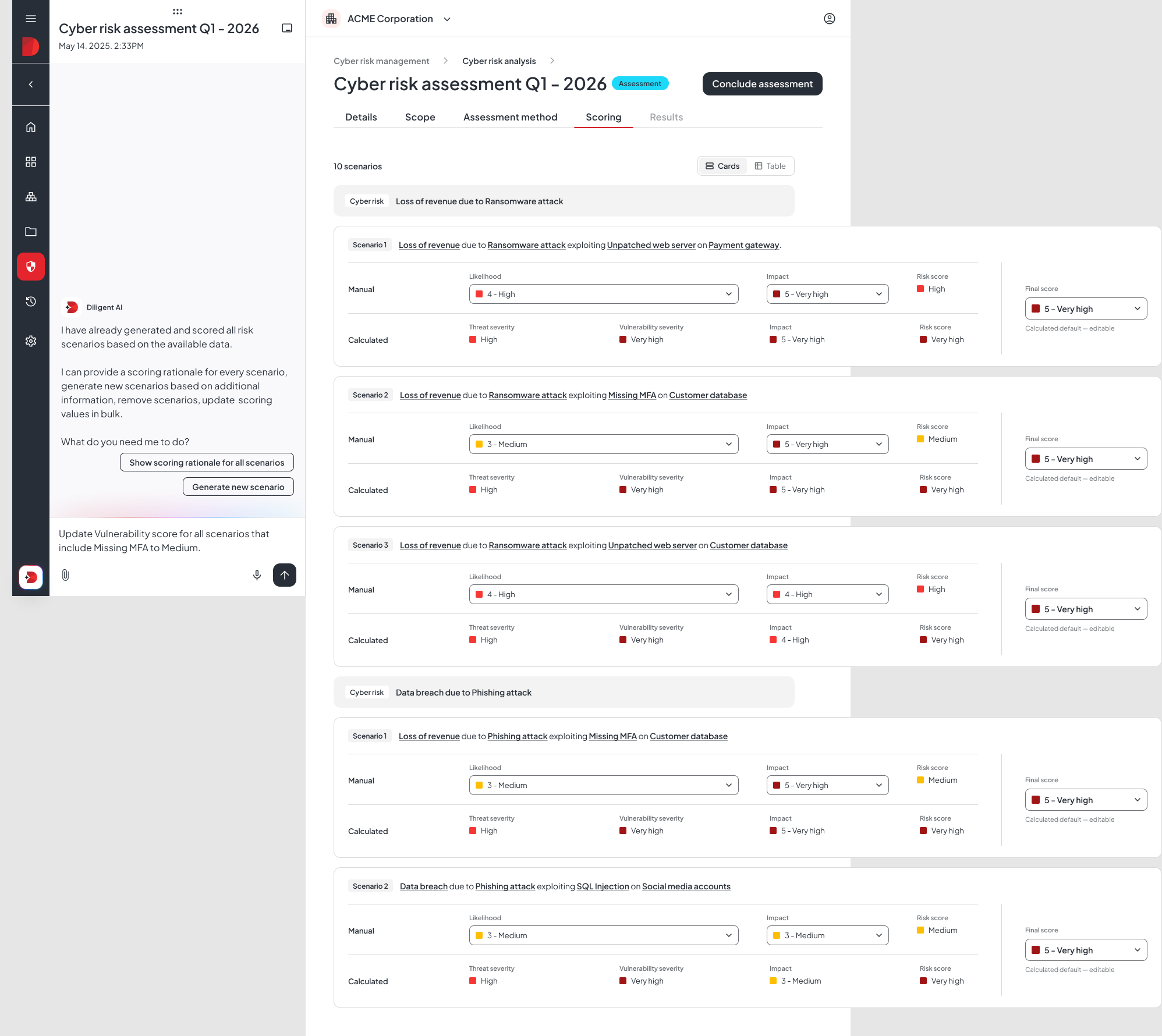
- 01
Qualitative assessment
Likelihood and impact give the professional a direct way to assess the scenario.
- 02
Calculated context
Technical inputs stay visible for comparison with the professional’s assessment.
- 03
Editable final rating
The final score is shown separately from the two assessment views.
My contribution
I partnered with the PM and supported the product designer, overseeing design and UX pattern consistency across products.
I led design critique sessions for the team, where we reviewed designs and discussed interaction patterns. These sessions were where we worked through how to apply those patterns consistently across products.
I also facilitated several product discovery workshops with subject-matter experts, where we validated user journeys.
The role of agentic AI
The early prototype explored how agentic AI could help with scope, scenario generation, scoring suggestions and rationales. Those interactions remain useful parts of the exploration.
In the revised direction, the risk professional’s assessment leads the scoring experience. Agentic AI supports the work of assembling and reviewing information around that decision.
User response
Users responded very positively to the revised approach. Adding the top-down assessment alongside the original bottom-up view gave us a direction they were happy with and a foundation to keep developing.
The first round of testing had exposed the gaps in our initial version. Deeper discovery and user journey mapping helped us work towards an assessment experience that users welcomed.
What comes next
This work is continuing. The next phase will build on the assessment experience, with planned areas including control effectiveness — understanding how well security measures are working — and automated controls.